How Generative AI Is Changing Software Testing and Coding Jobs
On this page
A tester used to spend a morning turning a requirements document into test cases. Now she can paste that document into an AI assistant and get a rough first set in a couple of minutes. A developer who once searched for boilerplate can ask for it from inside the editor. Generative AI in software testing and development is already part of daily work in many teams, and anyone about to enter the field is right to ask what it leaves for people to do.
The short answer is that the work is moving. Less of it is typing, and more of it is judging.
What generative AI already does in a developer’s day
Code assistants inside editors suggest completions, write a function from a one-line comment, explain code you didn’t write, and draft unit tests. Chat tools help read error messages, translate code from one language to another, and write documentation nobody wanted to write.
What comes back is a draft, and drafts can be wrong in ways that look right. An assistant may call a function that doesn’t exist, use a library the way it worked three versions ago, or handle the usual case and quietly miss the edge case. The Selenium project makes the same point in its guidance on using AI coding agents: models learned from years of older tutorials, so they tend to repeat patterns and APIs that have since been removed. Someone still has to read the code, run it, and answer for it when it breaks in production.
Generative AI in software testing: what changes
Testing is where the shift is easiest to see, because so much of it is structured text that AI handles well.
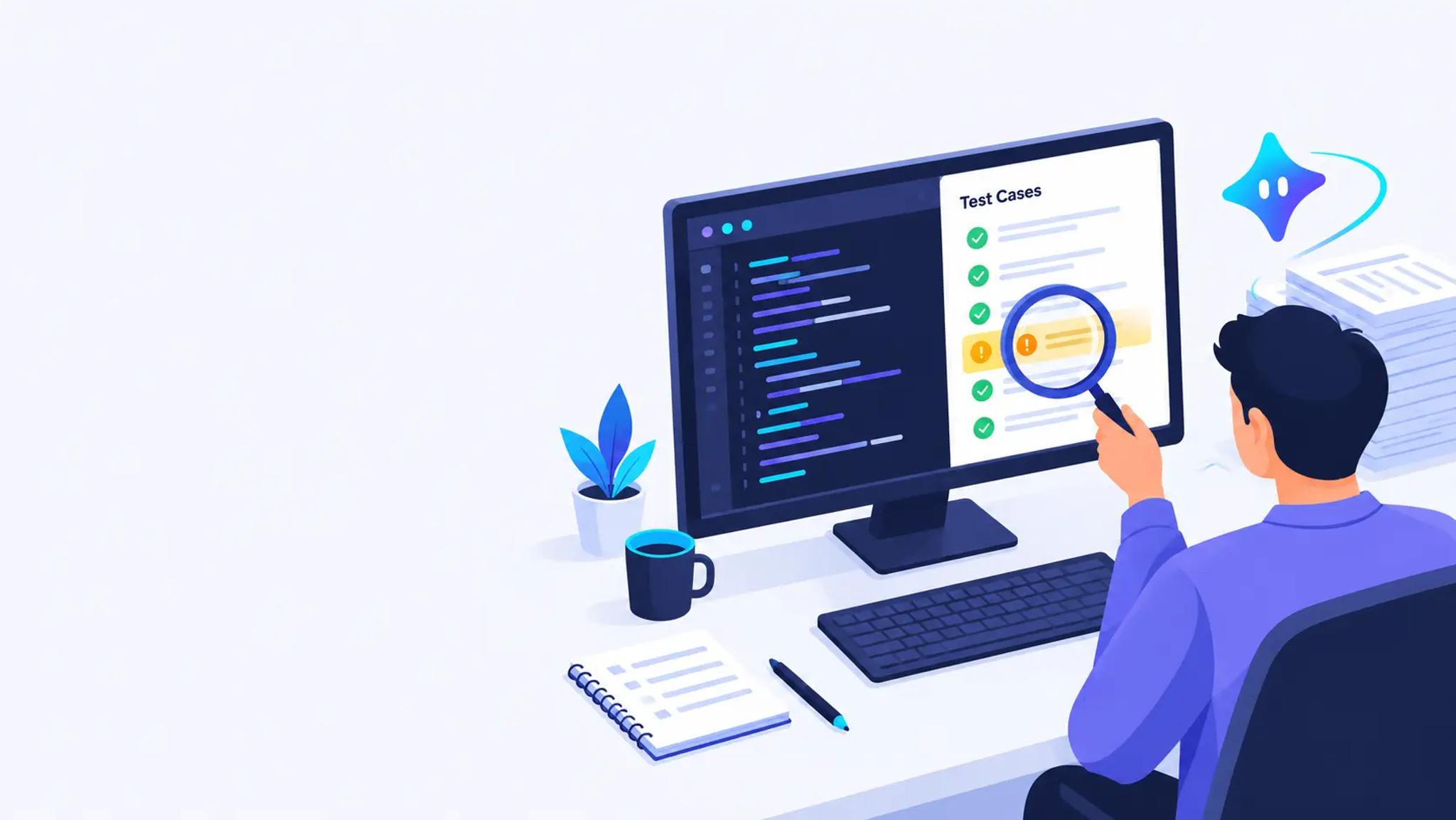
Test case design is the clearest example. Give a model a user story, acceptance criteria, or an API specification and it will propose scenarios, including negative cases and boundary values that a rushed human might skip. Automation scripts follow the same pattern. Describe a login flow and you can get a draft in Selenium, Playwright, or an API testing library. The tester then fixes the selectors, adds the right waits, since timing races are one of the main causes of flaky tests, and checks that the script tests what it claims to test.
Test data is another easy win, since AI can generate realistic names, addresses, and orders in bulk. Some tools also try to repair automated tests when a UI change breaks them, often called self-healing. That helps until a test heals itself onto the wrong element and passes while the feature is broken. A passing test you can’t trust is worse than a failing one you can.
AI is also useful for the tedious end of the job: summarising long logs, grouping similar failures, and turning rough notes into a readable bug report.
What it can’t do is know what your product is supposed to do. Requirements are often incomplete, and deciding whether a behaviour is correct for this business and these users is a judgement call. That stays with the tester.
There’s a newer task too. More products now contain AI features themselves, such as chatbots and recommendation tools. Their output changes from one run to the next and has no single right answer, so testers have to judge quality, fairness, and safety instead of comparing against a fixed expected value. Few teams have this skill in-house yet.
How coding jobs are shifting
The tasks shrinking fastest are the routine ones: scaffolding, simple scripts, repetitive CRUD code, first drafts of tests and documentation. Those tasks were also where many freshers used to learn. With a first draft one prompt away, employers look harder at whether a candidate understands what the code does, can review it, and can find the bug when it doesn’t work.
Job titles are mostly staying put. What changes is what a good day looks like inside them. Developers spend more time on design, review, and debugging, and less on writing the obvious parts by hand.
Nobody can say with confidence how hiring numbers will settle. Anyone quoting a precise percentage of jobs that will disappear is guessing. For a look at the local picture, our earlier article on how generative AI is changing software jobs in Kerala covers the market side in more detail.
Skills that matter more now
You can’t review what you can’t read, so fundamentals matter more than before. Data structures, how HTTP and databases work, and how to read a stack trace are what let you catch an assistant’s mistake. Debugging belongs in the same group.
For testers, test design thinking is the skill to build: equivalence classes, boundary values, risk-based prioritisation, and exploratory testing. AI can generate a hundred cases, and someone needs to know which twenty matter. Knowing your domain helps a lot here, whether that’s banking, healthcare, or e-commerce.
Writing clear requirements is a skill in itself. An assistant’s output is only as good as the instruction it got, and people who can describe behaviour precisely get better drafts and write better test cases.
Security awareness is also becoming part of the baseline. Generated code can include vulnerabilities, and pasting company code into a public tool can break confidentiality rules. Many employers now have a policy on this, so ask about it.
What students and career switchers in Kerala can do
If you’re learning to code, use an AI assistant, but write the first version of core exercises yourself. Then compare. You learn from the differences, and you build the habit of questioning output instead of accepting it.
If you’re in manual testing, the move that pays off is toward automation, API testing, and exploratory work. Learning a scripting language like Python is a practical start, and Selenium’s own getting started guide walks through setup in Python and several other languages. Our test automation training in Kochi covers the tooling side. If you want to understand how these models work and how to build with them, the artificial intelligence course is the closer fit, and the generative AI course syllabus and certification guide explains what such a course typically includes.
Whatever route you take, build one small project and test it properly. A portfolio piece with a test suite, a README, and a list of bugs you found and fixed says more to an interviewer than a certificate list.
Frequently asked questions
Will AI replace software testers?
Not the role as a whole, at least not soon. It is taking over repetitive parts of it. Testers who only execute scripted manual cases are the most exposed. Those who design tests, judge risk, and automate are in a stronger position.
Should freshers still learn to code?
Yes. Employers still need people who can read, review, and fix code, and you can’t do any of that without knowing how code works.
Is manual testing finished?
Scripted, repetitive manual testing is shrinking. Exploratory testing, usability checks, and work that depends on deep product knowledge still need people.
Master Data Science, Machine Learning & Generative AI
Learn from industry architects with hands-on capstone projects, real-world datasets, and official IIT certification.

Expertzlab Team
Senior Technical Architect with 25+ years of industry experience across enterprise architecture, AI, Big Data, and Full Stack development. Mentor and founder at Expertzlab.
Want the full curriculum & fee structure for Data Science with Generative AI?
Includes module-by-module breakdown, project capstones & placement roadmap.
Related Tech & Career Guides
 Career
Is a Indian Institute of Technology TIH Certificate Valid? Is It a Degree?
Find out what a TIH IIT certificate really is, when it counts as valid, why it is not a degree, and how to word it honestly on your resume.
 Data Science
Career Opportunities in AI Robotics for B.Tech Graduates in India
Explore career opportunities in AI robotics for B.Tech graduates in India: roles, skills, hiring sectors and a six-month plan to land your first robotics job.
 Career
MERN Stack vs Python Full Stack: Which Has More Jobs in Kerala?
Compare MERN stack vs Python full stack jobs in Kerala: where openings come from, which suits freshers, and how to check the market yourself. Read the guide.
Have Any Questions? Talk to an Advisor
Our expert career advisors are available 6 days a week to help you choose the perfect certification program and guide your tech career journey.