What Is MLOps and Why It Matters for Data Science Jobs
On this page
- What is MLOps?
- Why a model in a notebook is not yet a product
- How the MLOps lifecycle works
- Why MLOps matters for data science jobs
- Skills and tools to learn, and a sensible order
- Frequently asked questions
- How is MLOps different from DevOps?
- Can a fresher get an MLOps job?
- Does MLOps apply to generative AI?
- Conclusion
What is MLOps?#
MLOps, short for machine learning operations, is a set of practices for moving a model from experiment to a running service and keeping it healthy once it gets there. It borrows ideas from DevOps, such as automated testing and continuous delivery, and applies them to a system where the thing being released depends on data as well as code.
Google Cloud's MLOps architecture guide states the problem plainly: training a model is the easier part, and the real challenge is building an integrated ML system and running it in production. Its diagram of a real-world system shows the model code as one small piece, surrounded by data collection, data verification, serving infrastructure and monitoring.
Why a model in a notebook is not yet a product#
A notebook is a good place to explore and a poor place to run something other people depend on.
The first problem is that data keeps changing. Say a fraud model was trained on last year's transactions. This year customers behave differently, and the model gets worse even though nobody touched the code. The same Google guide notes that models can decay in more ways than ordinary software, so it asks teams to track summary statistics of incoming data and the model's live performance.
The second problem is the handover. In a common setup, a data scientist passes a trained model file to an engineering team, who rebuild the features for production by hand. If the two versions differ slightly, the predictions no longer match what was tested. It also gets hard to say which data and code produced the model that is running today.
How the MLOps lifecycle works#
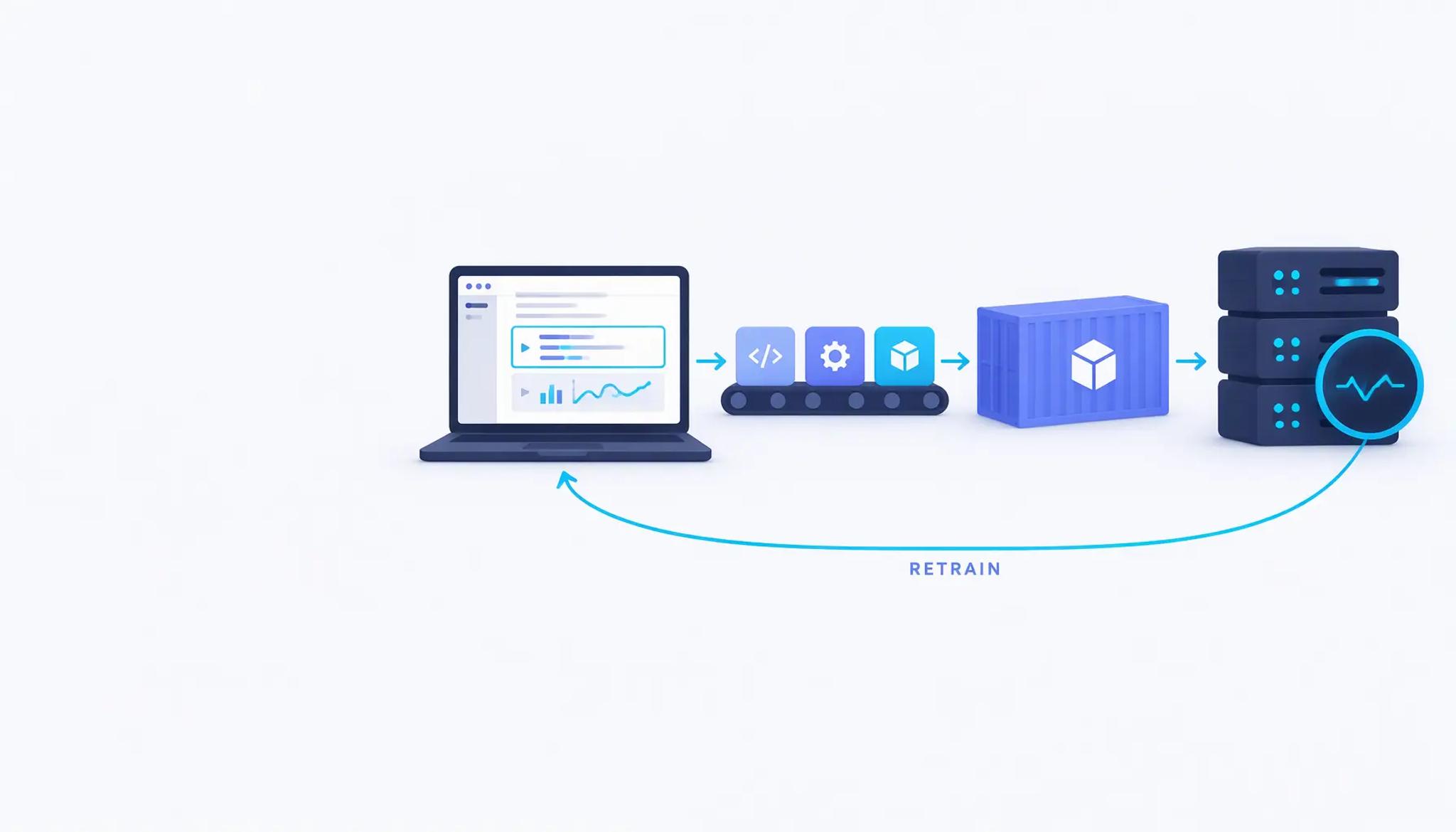
Teams describe the lifecycle in slightly different ways, but the stages are broadly the same:
- Prepare the data. Pull it from its sources, clean it, and add automatic checks for schema changes and unusual values before anything reaches training.
- Train and track. Run experiments and record each run's parameters, metrics and code version so any result can be reproduced later.
- Validate. Compare the new model with the one already in production and with a simple baseline, and check that it holds up across different slices of the data.
- Deploy. Package the model, often in a container, and release it through an automated pipeline as an API or a batch job. For background on containers, see our post on Docker, Kubernetes and service mesh.
- Monitor. Watch the live inputs, the predictions and the health of the service for drift and errors.
- Retrain. When monitoring shows decay, or enough new data arrives, the pipeline trains a fresh model and the cycle starts again.
Step 6 feeds back into step 2, which is why the lifecycle is usually drawn as a loop. Google's guide calls the automatic retraining part continuous training and describes it as a property unique to ML systems.
Teams automate these steps to different degrees. The guide defines three maturity levels: level 0 is fully manual, level 1 automates the training pipeline, and level 2 adds automated testing and delivery of the pipeline itself. It adds that you do not have to move everything up a level at once.
Why MLOps matters for data science jobs#
Employers want models that run in production, and Indian hiring data has started to show it. foundit's Insights Tracker counted about 2.9 lakh active AI job postings in India in 2025 and noted that hiring leaned toward deployment-ready skills, not only modelling. MLOps and model deployment appeared in 10% of those postings, up 42% on the year. Only generative AI and LLM skills grew faster, at 58%.
Ten percent is a modest share. Machine learning itself appeared in 34% of postings, so MLOps is a growing requirement but not yet a universal one. Postings can name several skills, so the shares overlap.
For a data scientist, this changes what a strong portfolio looks like. A project that stops at a notebook shows you can model. A project that ends with a deployed API, a tracked experiment history and a basic drift check shows you can deliver something a business can use. It also gives you more to talk about in an interview, because every stage involved a decision, such as how you validated the model or what you chose to monitor.
The skills behind those decisions are fairly consistent. In an analysis of 1,959 US MLOps postings from January to October 2026, Python appeared in 78.5%, cloud platforms in 70.1%, observability and monitoring in 67.7% and CI/CD in 59.3%. India's numbers agree on the basics: foundit found Python in nearly 75% of AI roles. The US analysis also found that no certification appeared in more than 1% of postings, which suggests a deployed project carries more weight than a badge.
For how the wider data roles compare, see our post on data analyst and data scientist roles in Kochi.
Skills and tools to learn, and a sensible order#
You do not need every tool at once. This order follows how the pieces depend on each other, and the posting shares come from the same US analysis:
- Python and Git. Python is the working language of this field, and Git keeps your code and experiments traceable.
- Serving a model. Wrap a trained model in a small web API using FastAPI or Flask and test it with sample requests.
- Containers. Learn Docker first, since about 40% of the postings name it, then take a first look at Kubernetes.
- Experiment tracking. MLflow is an open-source platform that covers experiment tracking, a model registry and deployment tools. It appears in just under 30% of postings.
- CI/CD. Automate tests and releases with GitHub Actions or a similar service. About 59% of postings mention it.
- One cloud platform. AWS leads at 53.3%, ahead of Azure at 36.8% and GCP at 29.7%. Our post on cloud computing jobs in Kerala is related reading.
- Monitoring. Add logging, alerts and a simple drift check on live inputs.
Then tie it together with one small project. Train a simple model, serve it through an API, put it in a container, track the runs, add a CI pipeline, deploy it to one cloud and log its predictions. One finished pipeline teaches more than reading about each tool separately. If you are still building the modelling base first, take a look at our data science training in Kochi.
Frequently asked questions#
How is MLOps different from DevOps?
DevOps automates how software is built, tested and released. MLOps does the same for machine learning but has more to cover. Google's guide says continuous integration now has to test data, data schemas and models as well as code, and that continuous delivery deploys a whole training pipeline that in turn deploys a prediction service. Continuous training, which retrains models automatically, has no equivalent in ordinary software.
Can a fresher get an MLOps job?
Most postings ask for experience. In the US analysis, 69% targeted mid or senior individual contributors, and most roles asked for around five years. A common route is to start in a data science, data engineering or software role and take on deployment work along the way, with a deployed project in your portfolio as proof.
Does MLOps apply to generative AI?
Yes. Versioning, evaluation and monitoring matter just as much for LLM applications. MLflow's documentation now covers tracing, evaluation and prompt management for LLM apps and agents alongside classic experiment tracking.
Conclusion#
MLOps is the part of data science that decides whether a model gets used. foundit projects India's AI job postings to reach nearly 3.82 lakh in 2026 and lists MLOps and deployment talent among the drivers of that growth, so the skill is likely to keep showing up in job descriptions.
A sensible next step is a small one: take a model you have already trained, put it behind an API and run it in a container.
Master Data Science, Machine Learning & Generative AI
Learn from industry architects with hands-on capstone projects, real-world datasets, and official IIT certification.

Expertzlab Team
Senior Technical Architect with 25+ years of industry experience across enterprise architecture, AI, Big Data, and Full Stack development. Mentor and founder at Expertzlab.
Want the full curriculum & fee structure for Data Science with Generative AI?
Includes module-by-module breakdown, project capstones & placement roadmap.
Related Tech & Career Guides
 Data Science
How Generative AI Is Used in Data Analytics Workflows
See how generative AI in data analytics helps with cleaning, SQL, code and reporting, and where a human must still check the output. A practical guide.
 Career
Is Indian Institute of Technology TIH Certificate Valid? Is It a Degree?
Find out what a TIH IIT certificate really is, when it counts as valid, why it is not a degree, and how to word it honestly on your resume.
 Data Science
Career Opportunities in AI Robotics for B.Tech Graduates in India
Career opportunities in AI robotics for B.Tech graduates in India: roles, employers, salary ranges, skills and a six-month plan. A guide from Expertzlab.
Have Any Questions? Talk to an Advisor
Our expert career advisors are available 6 days a week to help you choose the perfect certification program and guide your tech career journey.