Full Stack Developer Roadmap 2026: Step-by-Step Guide
Full Stack Developer Roadmap 2026: A Step-by-Step Guide for Beginners
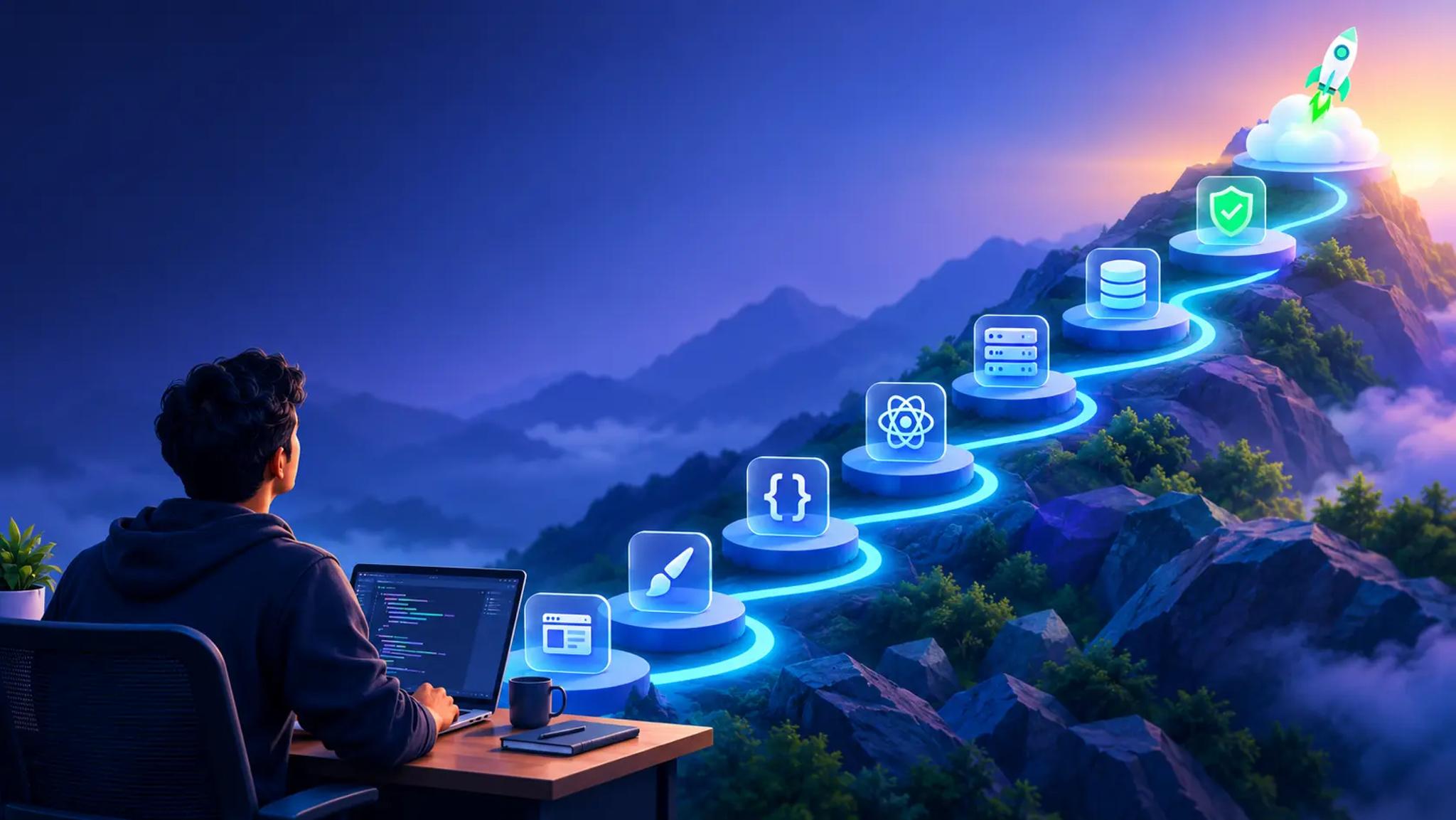
Search for a full stack developer roadmap and you’ll find lists with forty tools and no order. That’s the quickest way to burn out in month two. A full stack developer builds the part of an app people see and the part that runs behind it, and in 2026 the job also includes shipping the app, testing it and working alongside AI tools. This guide gives you the order to learn things in, what to leave for later, and what to build along the way.
What does a full stack developer actually do?
On the front end, you build what users see in the browser: pages, forms, buttons, layouts. On the back end, you build the logic, the APIs and the database behind them. The glue between the two is deployment, which means getting the app live on a real URL.
You don’t need to be an expert at everything. Most working developers are strong in one area and comfortable in the rest. Your goal is to take a feature from idea to live app without needing a teammate for every step.
Step 1: Learn HTML and CSS properly (weeks 1 to 6)
Start with semantic HTML, forms and basic accessibility. Then learn CSS layout with Flexbox and Grid, and build pages that work on a phone as well as a laptop. Make three things from scratch: a personal page, a landing page and a form with validation.
The free Learn web development course on MDN is a solid, structured place to begin. Don’t rush this stage. Weak layout skills show up in every project you build later.
Step 2: Get comfortable with JavaScript (weeks 6 to 12)
JavaScript runs the browser, and the 2025 Stack Overflow Developer Survey shows 66% of respondents using it. Learn variables, functions, arrays and objects, then the DOM, fetch and async/await, and ES6 modules.
Build a to-do app and a small app that pulls data from a public API. One rule helps here: don’t start a framework until you can build a small app without one.
Step 3: Pick up React and TypeScript (weeks 12 to 20)
React is the most-used web framework in that same survey, at 44.7%. The quick start on the React docs covers components, props, state and hooks, which is enough to begin. Add routing next, then TypeScript basics. Many teams treat TypeScript as the default now, and it catches mistakes before your users do.
Your project for this stage is a multi-page app that shows live data from an API.
Step 4: Learn a back end and commit to one stack (weeks 20 to 28)
There are three common routes, and any of them can get you hired.
The MERN route uses Node.js and Express, so you write JavaScript end to end. It’s a natural next step if you already know JavaScript. A MERN stack course in Kochi follows this path.
The Java route uses Spring Boot and is common in enterprise systems such as banking and large internal platforms. See the Java full stack course in Kochi for how it’s structured.
The Python route uses Django or Flask and works well when a product includes data or AI features. Here’s the Python full stack course in Kochi.
A 2026 hiring guide from Taggd groups the paths the same way: JavaScript stacks for fast iteration, Java for enterprise systems, Python for AI features. Pick one and stay with it. Switching stacks every month is how people end up knowing three half-finished things.
Whichever you choose, learn how REST APIs work: routes, status codes, validation and error handling.
Step 5: Databases, authentication and security (weeks 28 to 34)
Learn SQL with PostgreSQL or MySQL first. Design tables, write joins, and understand indexes. Then add MongoDB so you know how a document database differs.
Authentication is next. Learn sessions or JWTs, hash passwords properly, and check on the server that users can only see their own data. That last check is the one beginners most often skip. Keep secrets out of your code, and validate every input.
Step 6: Git, testing and deployment (weeks 34 to 40)
Use Git and GitHub every day from here on. Write unit tests for your logic and a few end-to-end tests for the main user journeys, with tools like Vitest or Jest and Playwright. Then set up GitHub Actions so the tests run on every push.
Deploy the app to a real host, and keep a separate staging copy so you can test changes safely. Deploying once isn’t impressive anymore. A repeatable, automated release is.
Step 7: Use AI tools well, then build with them (ongoing)
AI assistants are useful for drafts, boilerplate, explaining error messages and suggesting test cases. They’re also easy to misuse. If you lean on them before you understand the basics, you’ll get stuck at the first bug the tool can’t fix.
A good rule: don’t accept code you can’t explain. Review AI-written code as carefully as you’d review a teammate’s.
Once you’re comfortable, add one AI feature to a project, such as a chatbot, a summariser or smarter search, by calling a language model API. Scrimba’s 2026 roadmap lists AI integration as an emerging differentiator, and it’s a good talking point in interviews.
Step 8: Build a capstone and show your work (weeks 40 to 48)
Build one substantial app that pulls everything together: a React front end, an API, a database, login, tests, a live deployment, and a README that explains your decisions. A hiring manager can open a live demo and a clean repository. That proves more than any certificate.
Good capstone ideas include a booking system, a small marketplace, a job tracker or an expense app with reports.
How long does the roadmap take?
The weeks above add up to roughly eleven months. Scrimba’s roadmap estimates that most learners reach job-readiness in 8 to 12 months of full-time study, or 12 to 18 months part-time. Scrimba sells a course, so treat that as a rough guide, not a promise.
Structured classroom training with mentors can shorten the time you lose to getting stuck. It can’t shorten the practice hours, and those are yours. If you’re comparing options, our guide to choosing a software training institute in Kochi lists what to ask first. Coming from a non-IT background? This guide to switching to an IT career in Kerala covers the starting points.
Mistakes that slow people down
Watching tutorials without building anything is the biggest one. After every video, close it and build the thing again from memory.
Others are close behind. Skipping SQL because it feels old-fashioned. Learning three stacks at once. Never deploying, so every project lives only on your laptop. And ignoring communication: you’ll need to explain your project clearly in every interview.
FAQs
Which language should I learn first?
JavaScript. It runs in every browser and lets you build something visible quickly. Learn Python or Java later if your chosen stack needs them.
Do I need a computer science degree?
No. Many employers weigh your projects and fundamentals heavily, though some enterprise roles still ask for a degree. A deployed project with tests and a clean repository helps either way.
Can I become job-ready in six months?
Six months is fast. It’s possible with full-time study and strong mentoring, but most learners need longer. Plan for the longer timeline and treat anything faster as a bonus.
MERN, Java or Python: which is best?
The best one is the one you’ll finish. Choose MERN if you like JavaScript, Java if you’re drawn to enterprise software, and Python if you want to work with data and AI.
Will AI replace full stack developers?
AI is changing how developers work, but it hasn’t removed the need for people who understand how an app fits together. Developers who can review, test and secure code, and who can build with AI, are in a stronger position.
The bottom line
A full stack developer roadmap for 2026 comes down to a clear order: web basics, JavaScript, a front end framework, one back end stack, databases, testing and deployment, and then AI. Build something at every step, deploy it, and keep your capstone project polished. Start this week, even if it’s only the first HTML page.
Launch a High-Growth Tech Career with 100% Placement Support
Comprehensive career roadmaps, real interview preparation, and placement tie-ups with leading IT companies in Kochi & Bangalore.

Expertzlab Team
Senior Technical Architect with 25+ years of industry experience across enterprise architecture, AI, Big Data, and Full Stack development. Mentor and founder at Expertzlab.
Want the full curriculum & fee structure for Data Science with Generative AI?
Includes module-by-module breakdown, project capstones & placement roadmap.
Related Tech & Career Guides
 Career
Expertzlab vs Other IT Institutes: How to Choose the Right IT Institute in Kochi
Comparing an IT institute in Kochi? See what to check on certification, placements, projects and fees, and how Expertzlab measures up before you enroll.
 Career
How to Get an IT Job Without Experience: A Practical Roadmap for Freshers
Want an IT job without experience? Learn the skills, projects and job-search steps that get freshers hired, plus how Expertzlab in Kochi can help you start.
 Career
IT Courses in Kochi After B.Tech: Best Career Options 2026
Wondering which IT courses in Kochi after B.Tech lead to jobs? Compare data science, full stack, cloud, testing and more with 2026 fresher hiring trends.
Have Any Questions? Talk to an Advisor
Our expert career advisors are available 6 days a week to help you choose the perfect certification program and guide your tech career journey.